


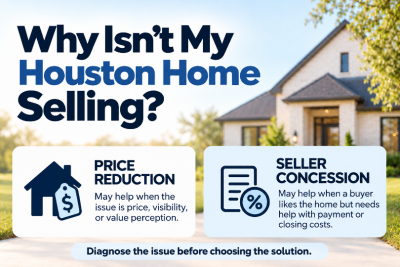
The answer depends on what buyers are telling you through showing activity, feedback, competing homes, and affordability. Before reducing the price or offering a concession, the first step is figuring out whether the issue is price, presentation, condition, buyer payment sensitivity, or simply a slower Houston real estate market.
| Quick Summary: If your Houston home isn’t selling, the right response depends on what the market is telling you. Limited showings may point toward pricing, presentation, or online positioning. Consistent showings without offers may indicate a value or condition issue. And when an interested buyer is primarily concerned about monthly payment, a seller concession toward allowable closing costs or a mortgage rate buydown may be more useful than an equivalent price reduction. |
When a home has been on the market for several weeks without an offer, the conversation often turns quickly to price.
Should you reduce the asking price? Offer a seller concession? Help a buyer buy down their mortgage rate? Complete repairs?
Any of those could be the right answer. But before making a change, there’s a more important question:
Why isn’t the home selling?
A price reduction won’t necessarily solve a condition problem. A seller concession probably won’t help if buyers aren’t interested enough to schedule a showing. And spending money on improvements may not make sense if similar homes throughout the neighborhood are experiencing the same slowdown.
The first step is figuring out what the market is actually telling us.
Houston Buyers Have More Choices Right Now
The broader Houston market provides useful context.
According to the Houston Association of REALTORS® August 2026 Housing Market Update, single family sales declined 11.5% from the previous year. Active single family listings reached 38,947 homes, while inventory stood at 5.3 months. Average days on market increased from 52 to 54 days.
That means buyers have plenty of choices, and when buyers have choices, they can afford to be more selective about price, updates, condition, floor plan, location, and future expenses.
But Greater Houston statistics only tell part of the story.
A three story townhome in The Heights or Montrose can face very different inventory and buyer demand from a single family home in Katy, Cypress, Pearland, or The Woodlands. Even two nearby neighborhoods at similar price points can experience very different levels of activity.
That’s why we want to understand what’s happening around your particular home, not simply what’s happening across Greater Houston.
What Is Your Listing Activity Telling You?
There isn’t one showing count or number of days on market that automatically tells us what to do next. Instead, we look for patterns.
| What We’re Seeing | What It May Indicate | What We’d Investigate |
| Very few showings | Price bracket mismatch, online positioning, photography, showing access, or broader market slowdown | Compare activity with nearby competition and review price search thresholds, photography, syndication, presentation, and showing availability |
| Consistent showings, but no offers | Buyers see enough value to tour but may perceive better value elsewhere | Follow up directly with showing agents, isolate recurring floor plan or condition objections, and determine what competing homes buyers chose instead |
| Buyers like the home, but stall on monthly payment | Affordability threshold or interest rate sensitivity | Evaluate a targeted seller concession toward allowable closing costs or a lender approved mortgage rate buydown |
| Repeated concerns about roof, HVAC, or deferred maintenance | Buyers may be assigning excessive cost or risk to the property | Obtain written bids from reputable contractors, complete strategic repairs, or consider a targeted seller concession |
These are clues, not automatic diagnoses. The important part is understanding why buyers are responding the way they are before recommending a solution.
Is Your Houston Home Getting Enough Showings?
Showing activity is one of the first things we evaluate when a listing isn’t moving.
How many buyers are coming through the home? Has activity increased, decreased, or stayed about the same? And perhaps more importantly, how does your activity compare with similar homes nearby?
If your home has had very few showings, buyers may be eliminating it before they ever walk through the front door.
That could point toward the asking price, photographs, online presentation, property condition, showing availability, location, or simply how the home compares with competing properties.
But context matters.
What Are Similar Listings Getting for Showing Activity?
There are times when activity slows throughout an entire neighborhood or price range.
When that happens, a lack of showings at one particular home may have less to do with the property itself and more to do with the overall market.
One thing a good listing agent can do is call the agents representing comparable homes nearby and ask what they’re seeing.
If several similar homes are each getting multiple showings a week while yours hasn’t had a showing in two weeks, that tells us something.
If those same agents tell us their showing activity has also slowed substantially, that tells us something different.
We’re trying to separate a broader market slowdown from something specific to the home.
Lots of Showings but No Offers Is a Different Problem
A home that isn’t getting showings requires a different conversation from one that’s getting plenty of showings but no offers.
If buyers continue walking through the home but nobody is writing an offer, we need to dig deeper.
This is where feedback becomes especially important.
A listing agent shouldn’t simply wait for an automated showing feedback form and consider the job finished. When a listing isn’t getting the response we expected, we should be following up directly with the agents who showed the property and trying to understand what their buyers thought.
Sometimes the feedback is specific:
“The primary bedroom was too small.”
“They need a larger backyard.”
“They don’t want a two story home.”
Those comments may involve characteristics we simply can’t change.
Other times, the feedback is much more generic:
“We didn’t like the floor plan.”
“It just wasn’t the right fit.”
“They liked another home better.”
When we repeatedly hear comments like these, the buyer may really be saying:
At this price, we liked something else better.
Buyers evaluate the entire package. Price, condition, floor plan, location, lot size, finishes, updates, and anticipated future expenses all influence how they perceive value.
We can’t change every characteristic of a home, but we can change how it’s positioned against its competition.
What Did the Buyer Purchase Instead?
One of the most useful pieces of feedback may not come from a feedback form at all. It’s what the buyer eventually purchased.
If someone toured your home and then bought another property nearby, we want to understand what that property offered.
Was it more updated? Was it priced lower? Did it have a better floor plan? Was the lot larger? Did it have a newer roof or HVAC system? Did the buyer simply perceive that they were getting more for their money?
One buyer’s decision doesn’t establish a trend. But when several buyers make similar choices, a pattern can begin to emerge.
That information can be much more useful than simply counting days on market.
| Wondering why your listing has stalled? Before making a price change, we can compare your showing activity, pricing, buyer feedback, and competition with similar homes in your specific Houston market. Contact The Moore Real Estate Group |
Houston Buyers Often Overestimate the Cost of Repairs
Property condition deserves particular attention because buyers don’t always know what repairs actually cost. So they estimate, and they frequently estimate high.
Imagine a buyer walking through a Houston home with an older roof and assuming replacement will cost $20,000 or $25,000. If a reputable roofing contractor evaluates it and provides a quote closer to $9,000, that’s an entirely different conversation.
Houston also has several property concerns that can make buyers particularly cautious.
An older HVAC system can feel like a major expense when buyers think about keeping a house comfortable through a Houston summer. Roof age can receive extra scrutiny after hurricanes, windstorms, hail, and other severe weather. Buyers may also become concerned when they see sheetrock cracks or signs of movement because expansive clay soils in the Houston area can move as moisture levels change.
None of those observations automatically means a home has a major problem. That’s exactly why good information matters.
The same concept applies to plumbing, electrical work, windows, flooring, exterior maintenance, and other deferred projects. Uncertainty creates risk in a buyer’s mind, and buyers frequently assign a larger number to that risk than the actual cost of correcting the issue.
Should Sellers Complete Deferred Maintenance Before Listing?
When we know a home has deferred maintenance before putting it on the market, The Moore Real Estate Group generally recommends addressing reasonable items in advance when doing so makes financial sense.
Removing an obvious objection can make a home much easier for buyers to evaluate.
But sellers don’t always want to complete every project before selling. In those situations, we’d rather understand the actual cost.
A reputable contractor quote gives the seller options. They can complete the work, provide credible information about the anticipated expense, or address it through negotiations if that particular issue becomes important to a buyer.
What we don’t want is a buyer mentally subtracting $25,000 from the value of a home for a project that might actually cost $9,000.
When Does a Price Reduction Make Sense?
Sometimes all of this analysis brings us back to price.
If comparable homes offer buyers more for their money, or repeated showing feedback indicates that buyers don’t perceive enough value at the current asking price, an adjustment may be appropriate.
Price also affects online visibility.
For example, if buyers are searching for homes priced up to $600,000 and your property is listed at $615,000, those buyers may never see it in their search results.
Advertising a $15,000 seller concession doesn’t necessarily solve that problem because the asking price remains $615,000.
Moving the price into another search range can introduce the property to buyers who weren’t seeing it before.
If you’re going to make a price adjustment, though, the change should have a purpose. Repeated small reductions that still leave the home positioned above its closest competition may accomplish very little.
Why Monthly Payment Matters to Houston Buyers
Some buyers are less focused on the purchase price than they are on their total monthly housing payment.
That can be particularly important in Houston.
In addition to principal and interest, buyers may be considering property taxes, homeowners insurance, HOA fees, and, depending on the community, MUD or other special district taxes.
Those expenses can materially affect the monthly payment even when two homes have similar purchase prices.
Mortgage rates make that calculation even more important right now.
As of September 24, 2026, Mortgage News Daily’s daily mortgage rate index showed the average 30 year fixed rate at 7.45%. The same source showed Freddie Mac’s weekly survey at 7.03%, illustrating how weekly surveys can differ from more current daily mortgage pricing.
For sellers, the important takeaway isn’t which survey has the better headline number. It’s that monthly payment matters to buyers.
When Does a Seller Concession Make More Sense?
This is where a seller concession can become extremely effective when it solves a specific problem.
Suppose a buyer loves the home but tells us:
“We need our payment closer to this number for the house to work for us.”
Now we have something specific to solve.
Depending on the buyer’s financing and lender requirements, a seller concession may be used toward allowable closing expenses, discount points, or an interest rate buydown.
Fannie Mae’s Interested Party Contribution guidelines specifically address financing concessions and temporary or permanent interest rate buydowns. When a seller or another interested party funds the buydown, the subsidy cost counts toward applicable contribution limits.
The Consumer Financial Protection Bureau’s guide to mortgage points and lender credits explains that paying discount points can lower a buyer’s interest rate in exchange for additional upfront cost. The amount of the rate reduction depends on the lender, loan type, and market conditions.
That’s why a seller concession can sometimes have a greater impact for a particular buyer than an equivalent reduction in purchase price.
If that buyer’s primary concern is monthly payment, helping fund an allowable mortgage rate buydown may address the actual obstacle preventing them from moving forward.
A Seller Concession Isn’t a Substitute for Correct Pricing
The important distinction is that concessions should solve a specific problem.
Offering a large concession simply because a home hasn’t sold doesn’t necessarily accomplish that.
If buyers believe competing homes offer better value, a concession may not overcome the underlying issue.
If buyers aren’t scheduling showings because the property appears overpriced online, a concession may not help there either.
And if nearly every buyer is concerned about obvious deferred maintenance, correcting the issue may be more effective than offering money around it.
The question shouldn’t simply be:
Should we reduce the price or offer a seller concession?
It should be: What’s keeping buyers from moving forward, and which tool best addresses that problem?
What Should You Review Before Making a Change?
- Are we getting enough showings?
- Are similar homes nearby getting more activity?
- What are buyers and their agents actually saying?
- Are we hearing the same objection repeatedly?
- What homes are buyers choosing instead of ours?
- Are buyers concerned about condition or deferred maintenance?
- Do we know what those repairs actually cost?
- Is the asking price keeping us outside an important buyer search range?
- Is a particular buyer concerned about purchase price, cash needed at closing, or monthly payment?
- Has the overall market slowed, or is the issue specific to our listing?
Those answers help determine what, if anything, needs to change.
Should You Reduce the Price After 30 Days?
There’s no universal 30 day rule.
Thirty days with steady showing activity and several interested buyers is very different from 30 days with two showings.
Thirty days during a period when comparable listings throughout the neighborhood are also sitting longer is different from 30 days when similar homes are receiving steady traffic and going under contract.
Days on market matters, but it needs context.
Frequently Asked Questions
Why is my Houston home getting showings but no offers?
Repeated showings without offers can indicate that buyers like the property enough to see it but don’t perceive enough value to move forward at the current price and terms. Buyer feedback, competing listings, and the homes those buyers eventually purchase can help identify the reason.
Should I lower my price if my Houston home isn’t getting showings?
Possibly, but price is only one potential cause. Compare your activity with similar listings, review the property’s presentation and photographs, make sure showing access isn’t an issue, and determine whether the broader neighborhood market has slowed before assuming price is the only problem.
Can a seller concession be used to buy down a buyer’s mortgage rate?
Yes, depending on the buyer’s financing and lender requirements. Seller funded contributions may be used toward qualifying temporary or permanent interest rate buydowns, subject to applicable contribution limits. The buyer’s lender should calculate the actual cost and payment impact.
Should I replace an older roof or HVAC system before selling my Houston home?
It depends on the condition, cost, and circumstances. When deferred maintenance is likely to become a significant buyer objection, completing the work may make sense. If you decide not to complete it, obtaining a reputable quote can help prevent buyers from dramatically overestimating the cost.
Will a seller concession help an overpriced Houston home sell?
Not necessarily. A concession can be effective when addressing a particular buyer’s closing costs or monthly payment, but it doesn’t automatically solve a pricing or value problem.
Is Houston currently a buyer’s or seller’s market?
Market conditions vary significantly by neighborhood, property type, and price range. Greater Houston had 5.3 months of single family inventory in August 2026, according to HAR, along with 38,947 active single family listings. That gives buyers substantial choice, but the more useful analysis for an individual seller is how inventory, pending sales, and showing activity compare within their specific micro market. View HAR’s Houston housing market data
The Bottom Line
When a Houston home isn’t selling, the answer isn’t automatically to reduce the price.
It also isn’t automatically to offer a seller concession.
Sometimes the right move is a price adjustment. Sometimes it’s addressing deferred maintenance. Sometimes it’s providing an actual repair estimate instead of allowing buyers to assume the worst. Sometimes a seller concession can help a particular buyer achieve a monthly payment that works.
And sometimes the data shows that activity has simply slowed throughout that segment of the Houston market.
The key is diagnosing the problem before spending money trying to solve it.
Thinking About Selling a Home in Houston?
If your Houston home is already on the market and isn’t getting the activity you expected, or you’re preparing to sell and want to avoid these issues from the beginning, The Moore Real Estate Group can help you take a closer look at what’s happening.
We’ll review competing listings, showing activity, buyer feedback, property condition, pricing, recent sales and pending homes, and what’s happening within your specific Houston micro market.
The goal isn’t simply to recommend a price reduction. It’s to understand what buyers are telling us and determine the best next step for your particular home.
Contact The Moore Real Estate Group to schedule a consultation and talk through your property, your market position, and your options.